
1. A refinance can hand you the job of paying your own property taxes, and most people don't notice until the following January.
2. Your homestead exemption is not automatic after a change to your loan or your title. Check it, don't assume it.
3. The number your lender appraised is not the number the county taxes you on. Two different systems on two different calendars.
4. Keep the appraisal report from your refinance. If the county comes in higher next year, that report is your evidence.
The refinance closes, the payment drops, and for a few months everything feels like it worked. Then a bill shows up in the fall with a number on it, and the question I get is always some version of the same one: I thought this was being paid for me.
It was. And then it wasn't, and the change was buried in a stack of paper on the day you were signing forty other things.
I've spent my career on the lending side of a home purchase, and the property tax side is where I watch good, careful homeowners get caught. So here's what actually changes, in plain terms.
The escrow account becomes optional, and that is not always good news
When you buy with a small down payment, your taxes and insurance get collected inside your monthly payment and held in escrow. The servicer pays the county for you. You never see a deadline.
Once you have more than about 20 percent equity in the home, that requirement usually goes away on a conventional loan. Waiving escrow is one of the fastest ways to lower a monthly payment, so it gets waived. It's a legitimate choice, and for a disciplined owner it's often the right one, because you keep the money in your own account until the bill is actually due.
But be clear about what you just agreed to. There's no third option here. Either the servicer pays your property taxes or you do. If you waived escrow, it's you.
January 31 is the date, and it is not a soft one
Texas property taxes for the year are due by January 31. On February 1 they're delinquent, and the state doesn't treat that gently: a 6 percent penalty plus 1 percent interest for that month, and the penalty climbs another point every month after that. By summer, an owner who simply forgot is looking at a number that has grown for no reason other than a missed date.
This is the part that catches first-time direct payers, and it usually has nothing to do with the money. For the last four years a company remembered the date for them. This year nobody did.
If you've waived escrow, treat January 31 the way you treat your own mortgage due date. Put it somewhere that will interrupt you. Bezit built View My Bill for exactly this gap: it tracks the bill, tells you what's owed and when, sends the reminder, and lets you confirm the payment actually posted. It's free, and you don't have to be a Bezit client to use it.
I've found View My Bill extremely useful myself. It shows the preliminary tax bill and the certified one, the history from past years, and whether the taxes were actually paid. Though your home is appraised by one county, sometimes homeowners pay taxes to two counties. It's difficult to check all of that in one place, and Bezit solved that problem. I highly encourage every homeowner to check their taxes on Bezit.
Check your homestead exemption. Do not assume it survived.
The homestead exemption is a free reduction in the taxable value of your primary residence, and in Texas it also caps how fast that taxable value can climb year over year. It's one of the most valuable things a homeowner has, and one of the easiest to lose track of.
A straightforward rate-and-term refinance normally doesn't disturb it. But “normally” is doing a lot of work in that sentence. If a name came off the title or went on it, if the property moved into a trust, or if the home is a newer build where the exemption was never filed to begin with, the picture changes. And unlike a late payment, nothing announces this. You find out when the bill is larger than it should be, sometimes a year later.
Checking takes a few minutes. Look your property up on the county appraisal district's site, or run it through Bezit, which checks exemption status as a matter of course for every homeowner it works with and files homestead applications at no charge.
No, refinancing does not raise your property taxes
This is the question I get most on a cash-out, and the answer is no.
The appraisal done for your loan exists to support the loan. It goes to the lender. Your county appraisal district isn't on that distribution list, and it doesn't use it.
The county sets its own value on your property as of January 1 each year, using its own mass appraisal of your area. Different organization, different number, produced for a completely different reason. Pulling equity out of your home doesn't move it.
What does move it is the county's own opinion of what your home is worth this year, and that resets every January whether you refinance or not. That's a different problem, and it's the one Bezit exists to argue about.
Keep that appraisal report. It is the best evidence you will ever get for free.
Here's the part almost nobody is told.
When you refinance, a licensed appraiser walks your home and writes a report. You paid for it. It's dated, it's independent, and it's about your house rather than your zip code. Then it goes in a drawer and stays there.
Now picture the following January. The county mails your appraisal notice, and its number is higher than the appraiser's was.
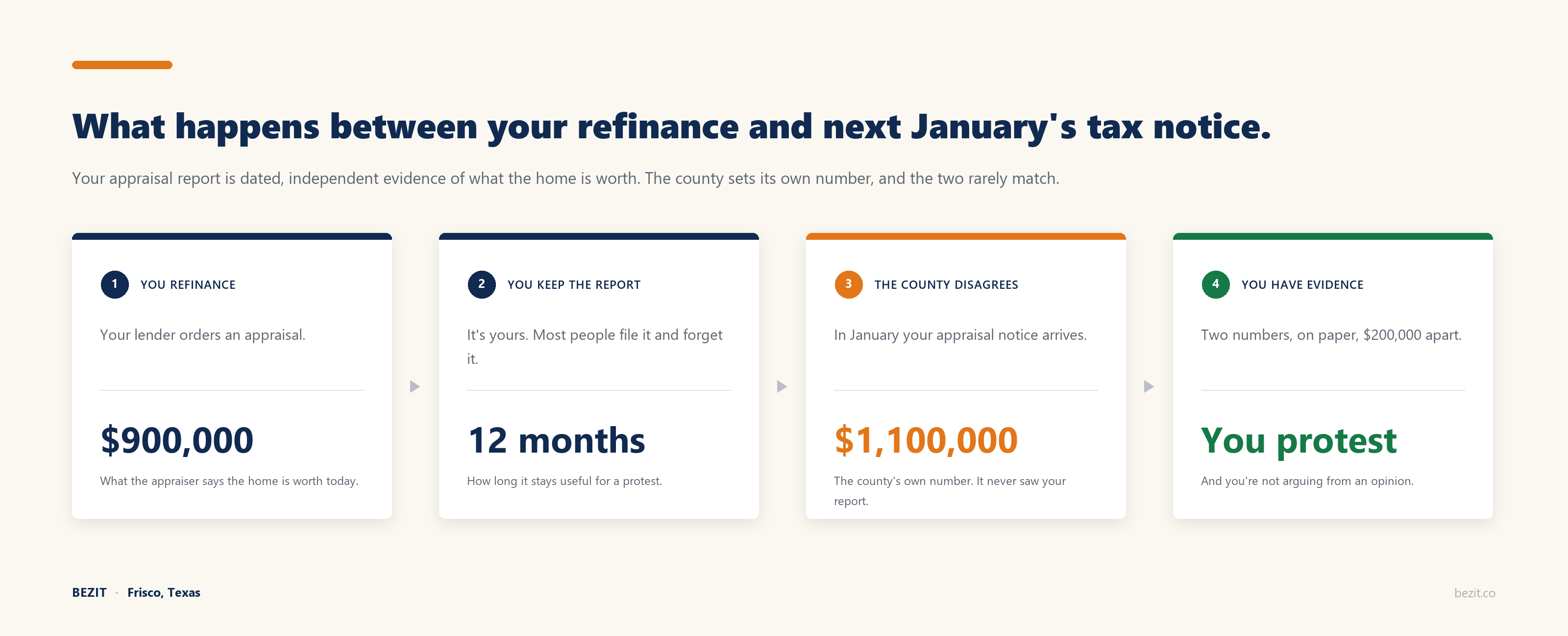
Say the refinance appraisal came back at $900,000 and the county's notice says $1,100,000. You are not stuck with the county's number. You have a recent, professional opinion of value that disagrees with it by $200,000, and you can protest on exactly that basis.
And it matters more after a refinance than almost any other time. If you waived escrow, the full tax bill now lands on you directly instead of hiding inside a monthly payment. If it's your homestead, the value you settle on this year is the base the county's 10 percent cap grows from next year, so a number you let stand carries forward. A value you don't protest is a value you've accepted.
Three numbers decide how much you can save. Line all three up before you file, and you know whether you have a case before you spend a minute on it.
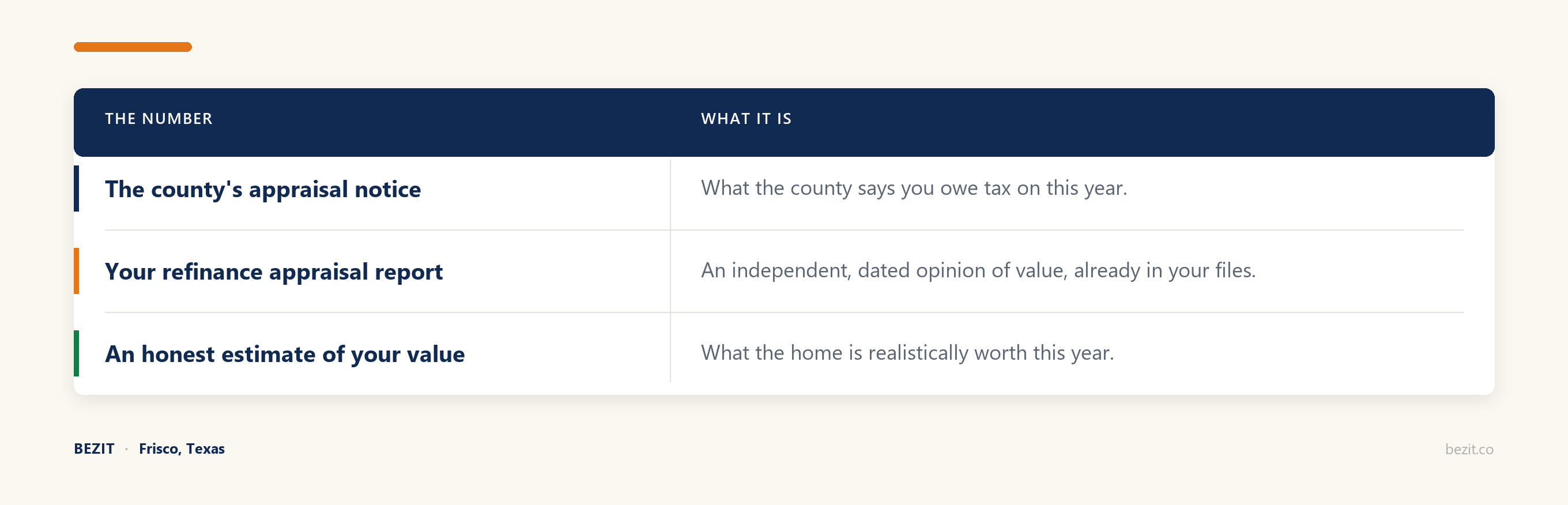
That last number is the one most homeowners can't produce on their own, which is where Bezit comes in. If you refinanced in the last twelve months, send Bezit the appraisal report. They validate it, compare it against the county's value and their own comparable-sales work, and if there is a case they run the protest for you at no charge. Bezit doesn't charge for a new homeowner's first protest either, and on everything else its residential fee is 10 percent of what it saves you, billed only when it wins.
Don't throw the report away. Twelve months is a long window, and it costs you nothing to keep it.
What to actually do
If you refinanced this year, or you're about to, five minutes covers it:
- Find out whether you still have an escrow account. Your servicer's statement will say. If you don't, the tax bill is yours.
- Save the appraisal report from your refinance somewhere you'll find it next spring.
- Put January 31 on your calendar with a reminder in early January, not late January.
- Confirm your homestead exemption is on file for this tax year.
- Set up a way to be told, rather than a way to remember. That's what View My Bill does.
- Look at the county's value on your home, not just the tax amount. The bill is the county's value multiplied by rates you can't negotiate. The value is the part that can be challenged.
- If the county comes in above your refinance appraisal, protest it. Send the report to Bezit. They'll tell you whether there's a case and run the protest for you.
None of this is complicated. It's just that nobody is assigned to tell you, and the systems that used to catch it for you stopped when you signed.
About the author
Renuka Samudrala is the CEO of PureLend Mortgage LLC, a direct lender based in Lewisville, Texas. Purelend works with homeowners on purchase, refinance and cash-out loans and is licensed for residential lending in AR, CA, CO, FL, GA, MI, MD, MN, NC, NJ, OH, PA, TN, TX and VA.
Renuka Samudrala,
NMLS: 1487363
Purelend Mortgage LLC
Company NMLS: 1718537
Ph: 214-529-5351
Fax: 972-525-7152
Email: renuka@purelendmortgage.com
purelendmortgage.com
Address: 2681 MacArthur Blvd, Suite 206, Lewisville TX 75067